The Kiwi Pet Sitter Checklist: What Every Professional Needs
What does a professional pet sitter need in New Zealand?
There’s no formal national licence for pet sitters, so professionalism comes down to what you can show owners: a current criminal record check, references, a service agreement, your own terms and conditions, and a code of conduct you work to. As your business grows, insurance and extra training add to that. This checklist covers each one and how to keep it up to date.
1. Keep your CV current
Your CV is often your first impression. Update it with new training, certifications, services and experience, so you’re ready to respond quickly when owners ask about your background.
2. Get a current criminal record check
Owners want peace of mind, and a recent check is one of the most reassuring things you can show them. In New Zealand you request your own check from the Ministry of Justice, and it’s free. Apply online at https://www.justice.govt.nz/criminal-records/get-your-own/ and allow up to 20 working days in case it’s slow.
We recommend renewing it every 12 months, and PSNZ verified members renew theirs annually.
3. Gather your references and reviews
Reviews and references show owners you’re reliable. There are two good ways to collect them:
- Online reviews: A Google profile or Facebook page lets owners leave public reviews, and you can send new clients straight to them.
- Written references: For owners who don’t use social media, ask for a signed reference with their contact details and permission to be contacted.
Either way, tell your references they may be contacted, and make sure they’ve agreed to it.
4. Sign the Pet Care Code of Conduct
A code of conduct shows owners the standard you work to. The Pet Care Commitment Code of Conduct is built around NZ animal welfare standards and developed with vets, dog trainers and other pet professionals. Register as a PSNZ member, sign the Code and earn your first badge, which you can use on your website and social media.
5. Know the NZ laws that apply to your work
Pet sitters are expected to understand the Animal Welfare Act 1999 and the Dog Control Act 1996, including the basics of leash rules, registration and microchipping. Before you take a dog out, check that it’s registered and microchipped, and if it isn’t, raise it with the owner. The PSNZ Code of Conduct summarises the key obligations in plain language.
6. Have a service agreement and your own terms and conditions
These are two different documents, and professional sitters need both.
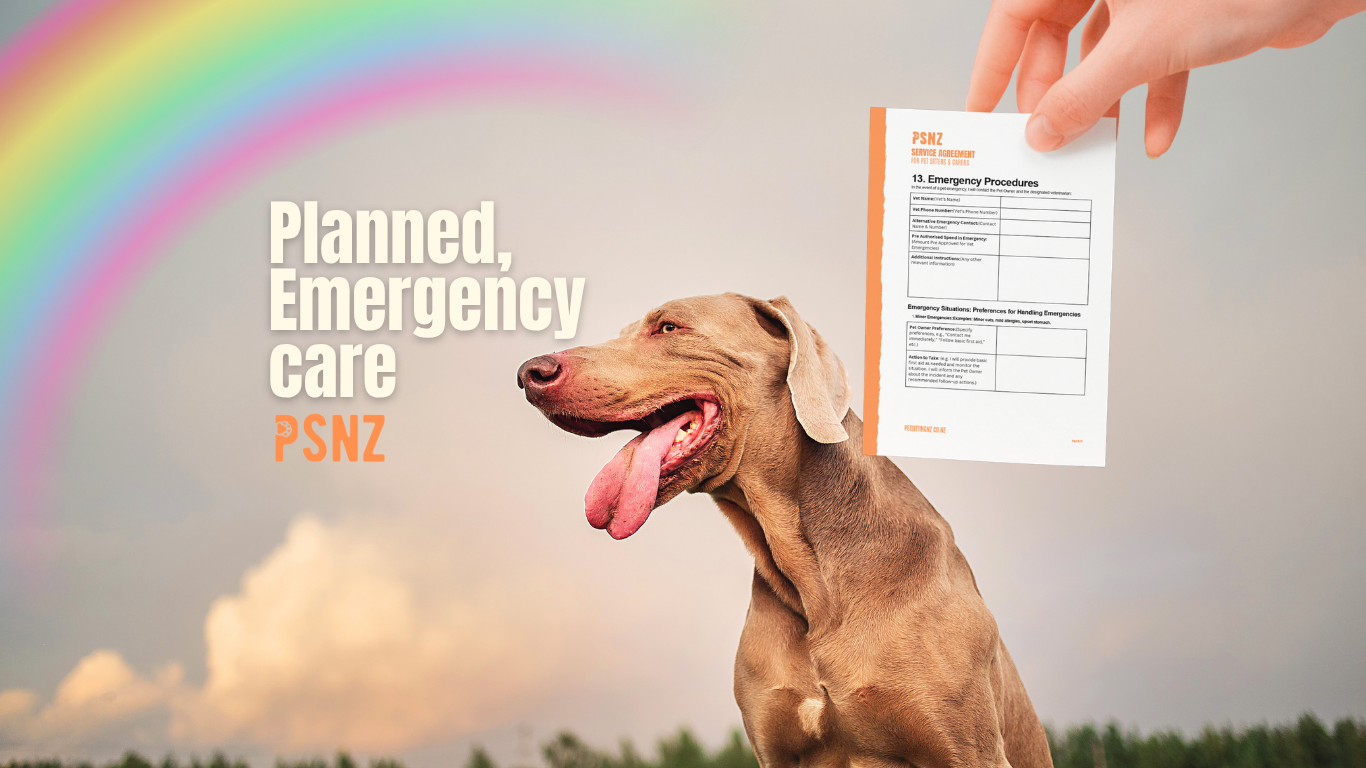
- A service agreement is signed with each client. It sets out care instructions, feeding and medication, emergency contacts, vet details, access to the home and payment, so everything is agreed before the sit. Free and paid PSNZ members can use our Service Agreement template, written for Kiwi sitters.
- Your own terms and conditions set out how your business works: your cancellation policy, payment terms, liability, what you will and won’t do, and how you handle emergencies. PSNZ verified members get a terms and conditions template to build theirs from.
Review both regularly so they match your current services and prices.
7. Be ready for the meet and greet
A meet and greet before every new sit lets you learn the pet’s routine, the property and any other animals, and lets the owner see how you work. Go in prepared: bring your service agreement and a list of questions about feeding, medication, behaviour, vet details and emergency contacts. For dogs, a short walk together shows you how the dog handles other dogs and people.
8. Keep good records and understand your tax obligations
Keep copies of every service agreement, care instructions, invoices and sit notes. Records protect you and the owner if there’s ever a dispute.
Keep your financial records just as carefully:
- Keep every receipt and proof of payment, including petrol, supplies, insurance, training, phone and marketing costs. Store them in one place, such as a folder or an app, as you go.
- Record every payment you receive, with the date, client and amount.
- Understand your tax obligations. Income from pet sitting generally needs to be declared to IRD, and you may be able to claim some business costs. Look at IRD’s guidance on self-employed income and on whether you need to register for GST.
Good records make tax time much easier. This is general information, so ask an accountant or IRD about your own situation.
9. Think about insurance (when you can)
Insurance isn’t compulsory for pet sitters in NZ, but it’s good practice and a safety measure, and many owners will ask about it. It protects you and the owner if something goes wrong, such as an injury, damage to a property or a lost key.
We also know it can be hard to afford. For many sitters, especially when you’re starting out, it’s a significant cost. A reliable client base with ongoing work is often what makes insurance a viable business expense, so it’s something to build towards rather than a box you have to tick on day one.
In the meantime, you can prepare:
- Get quotes from a few providers so you know what cover costs and what’s included, such as public liability and cover for lost keys
- Check what’s excluded, for example boarding, house sitting or certain animals
- Plan for it as a business cost and factor it into your rates once you can afford it
Our Pet Sitter Rate Calculator helps you gauge what your should charge for your pet care services.
10. Invest in pet first aid and dog safety training
Training is one of the best ways to build your credentials and your confidence. Two courses are particularly valuable for professional sitters:
- Pet first aid helps you recognise and respond to emergencies, and know when to get your vet involved. It’s something owners are glad to see on a sitter’s profile. Discount available for PSNZ registered members.
- Dog Safe Workplace training teaches you to read dog body language and work safely around dogs, which protects you, the dog and the owner. Discount available for PSNZ registered members.
Both add to your professional development and show owners you know how to care for pets in an emergency and work safely. PSNZ partners with industry providers and promotes their courses, and we often offer members a discount where we can.
Like insurance, training is an investment. Take it one step at a time and add courses as your business grows.
11. Get verified
Once you’ve signed the Code, verification takes you a step further. You show your ID, provide a clean criminal record check and give three references. Verified members get a Verified badge and a profile in our public directory, for $9.99 a month or $100 a year, with no commission on your bookings.
Join PSNZ → Sign the Code → Get verified
Frequently asked questions
Do pet sitters need a licence in NZ?
There’s no national pet sitter licence. Some councils have rules for related services like boarding or dog walking, so check with yours.
Do pet sitters need insurance in NZ?
It isn’t compulsory, but it’s strongly encouraged as good practice and a safety measure. It can be expensive, so many sitters add it once they have a steady client base. Get quotes from a few providers so you know what’s available.
How often should I update my criminal record check?
Every 12 months is a good standard, and it’s what PSNZ requires of verified members.
Is a criminal record check free in NZ?
Yes. Requesting a copy of your own record from the Ministry of Justice is free.
Do pet sitters have to pay tax in NZ?
Income from pet sitting generally needs to be declared to IRD. Keep your receipts and records, and check IRD’s guidance or ask an accountant about your situation.
What documents should a pet sitter have?
A recent criminal record check, references or reviews, a service agreement, your own terms and conditions, and proof of insurance and training if you have them.
A well-prepared pet sitter is a trusted pet sitter. Set a reminder to review this checklist each year.
Support local. Sit with purpose. Care with confidence.